Let’s talk about this.

I’ve been sitting here staring at my new Ibis Ripmo v3. I can’t ride it because I’m waiting on a mount for the electronic wireless shifting pod. If you’re curious about that story, it’s in the video.
I got to thinking… Is the new electronic shifting revolution really “all that”? What makes it “better” than traditional cable-driven shifters, and why should I spend all the extra dough to have the latest and greatest?
The Concept
We’re only talking about mountain bikes today. Sure, road bikes have a lot of fantastic cable-driven and electronic shifting options, but the same rules generally apply to both platforms. So we will stick to mountain bikes today. They are what I have in the shop, and it’s just easier to not over-complicate the concepts.
The big players in this market are SRAM and Shimano. SRAM is the American made option that – to a certain extent – pioneered electronic wireless shifting and brought it into the mainstream. Shimano, while late to the wireless game, can be referred to as the “old guard” who developed and/or perfected a lot of tech that was once experimental, but that we now call “common”. Index shifters, anyone?
These industry behemoths both have wired and electronic options in their drive train line-ups. They run a wide gamut, from mid-level options all the way up to race grade options like SRAM XX1 and Shimano XTR. It is possible to spend quite a bit of money on this stuff!
These systems deserve their spot at the top of the list as a clean and reliable way to shift your bike.
Differences
Cable Shifters
Cable-based shifting has been around for almost 100 years. It was introduced on simplex systems in the late 1930s and quickly became a standard. When multi-geared bikes were a new fad, the cable-driven concept made it possible to change those gears without the need to reach down and whack a lever near your rear hub. It was all simple and easy to manage right from the handlebar.
These systems deserve their spot at the top of the list as a clean and reliable way to shift your bike.
But cable systems have always had their drawbacks. These systems consist of friction parts that wear down over time. Cables, housing, ferrules, end caps, barrel-adjusters, and mounts can easily get gunked up with road grit and bind. Rust can form inside the housing – where the rider cannot see it – and create invisible problems. And managing these issues can be tricky and messy.
Anyone who has had to deal with internal cable routing (where the cables run though the inside of the frame) knows that it may solve routing issues and look clean, but they also create a new set of headaches. Pivot points can bind cable runs and routing the cables is often tricky and labor intensive.
Electronic Shifters
Electronic shifting systems fall into two categories; wired and wireless. Wired shifters use a thin wire that runs from the shifter down to the rear derailleur. Wireless uses RF signals to transmit an encrypted signal, telling the derailleur when and how to shift. Both are effective, but one is distinctly better.

The wired systems, while a necessary step in the evolution of electronic shifting, will likely go away completely in the near future. They are prone to issues like snagging on stationary objects (in the shop, on the road, and on the trail), and are just a lot more cumbersome. Wireless, however, gives a cleaner cockpit and is very secure, robust, and reliable.
Electronic wireless systems are getting cleaner and lighter every year. SRAM entered the market in 2019 with their “AXS” product line. They are now on their second release with the “Transmission” drivetrain technology. These newer systems are insanely robust and work every bit as well as their cable-driven counterparts. Many would say they work much better.
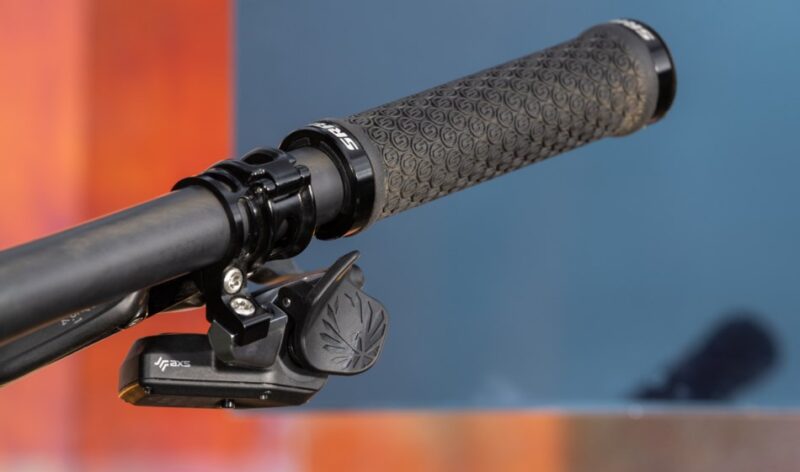
Shimano is late to the game in terms of electronic wireless systems. They have had electronic solutions for many years (called “Di2“, was there ever a Di1?) but they ran wires to transmit the signals. Their newer systems use RF and appear to be every bit as sturdy and reliable as SRAM’s offerings.

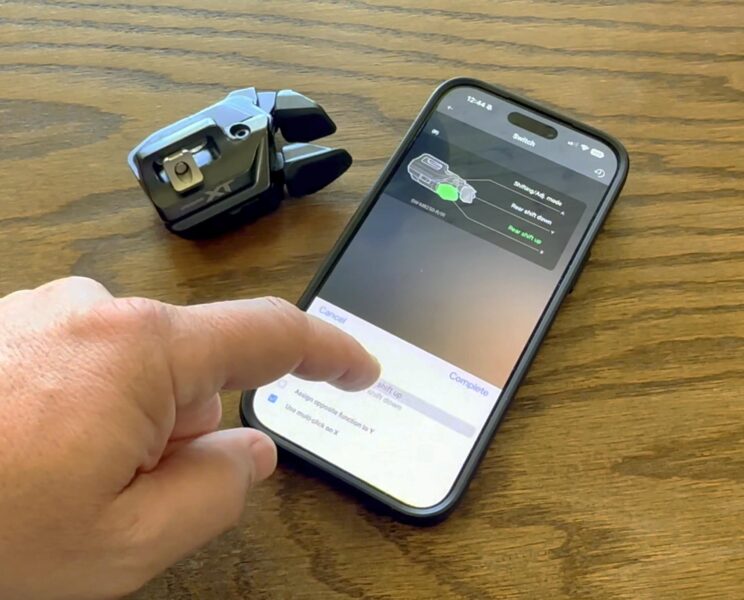
SRAM has a clean and easy to use system for managing the AXS setup. Their “SRAM AXS” app allows the rider to manage and control the implementation of their shifting system, and even integrate the SRAM Reverb wireless dropper post! It is a well-designed system that works reliably and functions well.

Shimano’s “E-Tube” app is, well, clunky. While it works perfectly well, the interface leaves a lot to be desired. Pairing the app is fairly straightforward, but applying changes to the setup requires un-pairing and re-pairing every time you make a change. Combine that with un-intuitive interface decisions and it creates an environment where, while it gets the job done, requires a lot more work to get there.
Conclusion
I only know what I have used. I’m not trying to say that SRAM and Shimano are the absolute best options out there, but they are the biggest players in the market and they do a lot to move the technologies forward. I use them primarily because it’s easier to find parts when on a remote mountain biking trip. Oh, and they work reliably also!
If you are curious about these systems, I would encourage you to go rent a bike that uses them and take it for a ride. While both offer great experiences, you may find that one system suits you more than another. The shifting pods, for instance, are very different and are customizable in ways that may make a big difference to someone who is planning an upgrade in the near future.
Thanks for reading, now go watch the video! And get out there and ride!